Review the process and model
We establish the tooling purpose, dimensions, allowances, parting lines, draft, tolerances and surface requirements.

Industrial tooling
We print a large near-net blank with machining allowance, then CNC-machine it to the agreed geometry. The master is used to make moulds, tools and production patterns.
Discuss a master pattern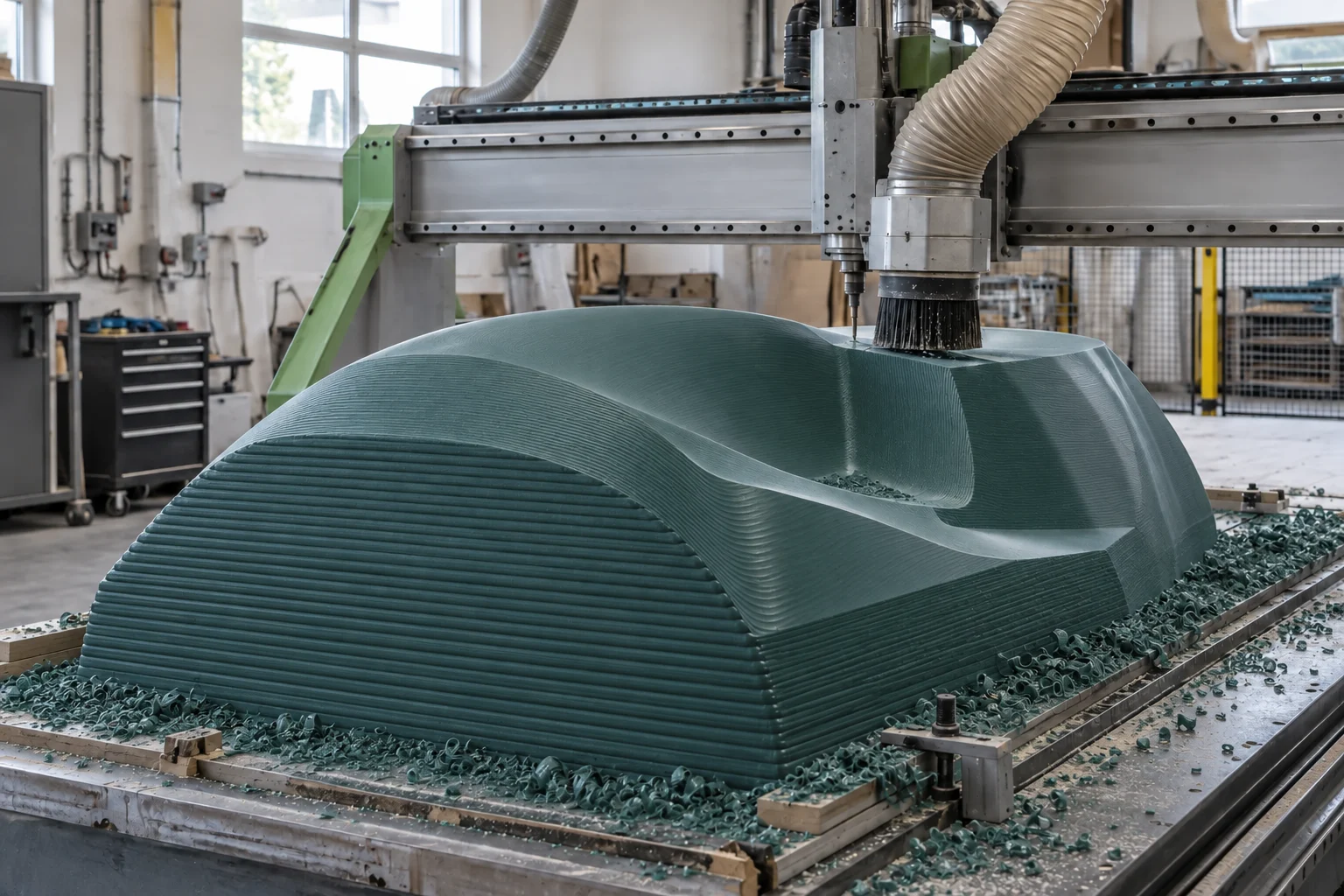
A master pattern reproduces the original positive geometry. A working negative mould or tool is then made from it for casting or forming. Printing builds the large volume quickly; machining establishes interfaces and the required surface.
In some processes the printed part can be used directly as tooling, but only after engineering review. Temperature, vacuum, pressure, chemical compatibility, cycle count and surface requirements determine the material, structure and finishing route.
We establish the tooling purpose, dimensions, allowances, parting lines, draft, tolerances and surface requirements.
Large-format pellet FGF printing creates a shape close to final geometry with a controlled machining allowance.
We remove the allowance, establish datum surfaces and machine the geometry to the parameters agreed before production.
The master is ready for the sealing, coating and mould-making steps defined by the project. The exact scope is stated in the quotation.
These are typical routes. For every project we first review the working medium, temperature, pressure, release method and required tool life.
Masters for moulds used to cast rigid or flexible polyurethane foam, accounting for expansion, venting, parting and demoulding.
Master patterns and moulds for hand lay-up, vacuum infusion and other agreed processes. Vacuum and cure temperature must be specified in the brief.
Masters for production moulds for tiles, landscape elements and other products. Pressure, heat, release system and planned cycle count are reviewed in advance.
Patterns for flexible or composite moulds used for panels, reliefs, décor and small architectural concrete forms.
Master patterns for moulds used to make plaster décor, panels, three-dimensional elements and short production runs.
Positive tools and masters for thermoforming plastic sheet. Draft, working temperature and vacuum channels or perforation must be engineered.
Tooling and masters for epoxy casting, with the exotherm, casting thickness, sealing and release system checked for each project.
A master can be used to make a silicone mould. Casting silicone parts requires a separately designed rigid tool and parting system.
Patterns for moulded-fibre and papier-mâché products. Production tooling for moulded pulp needs a separate screen, drainage and vacuum design.
These uses are technically related to hybrid printing and machining, but are accepted only after reviewing the production requirements.
Large patterns and segments for sand moulds, allowing for foundry draft, machining allowance and the customer's material shrinkage.
Assembly, inspection and trimming templates, nests and complex holding fixtures for production environments.
Low-temperature moulds and vacuum tools without an intermediate master, subject to material, sealing and load validation.
The better the downstream production process is defined, the more reliably we can choose the blank structure, machining allowance and CNC scope.
A printed master pattern is not automatically a production-ready mould. The quotation separately states the material, machining allowance, machined sides, tolerances, sealing, coating and responsibility for the final mould.
Describe the end product and the process that needs the master. Attach a 3D model, drawing or reference and include dimensions, mould material, temperature and planned quantity when known.
Projects start at RUB 50,000.
Timing and scope are confirmed after reviewing the geometry and tooling requirements.
Your project description and contact details are sent to our team.
Send by email: info@trashback.net