
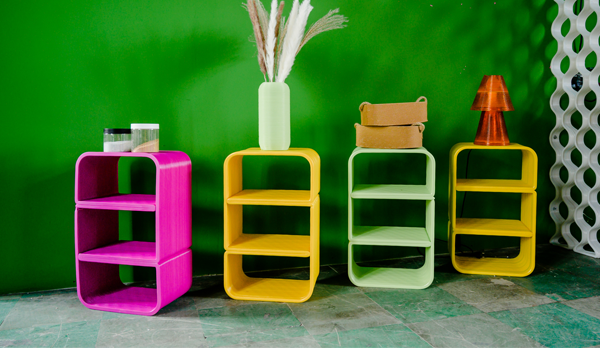
Start with the boundaries of the process
This is not desktop printing for figurines or small parts. Large-format FGF printing uses plastic pellets and is intended for furniture, counters, planters, enclosures, art objects and other large items for businesses and public spaces.
The process does not replace every furniture-production method. Its strength is project-specific objects with complex geometry, one-offs and short runs for which dedicated tooling would not be practical.
1. Freedom of form
The printer deposits material along a digital path, enabling smooth transitions, curved surfaces and continuous volumes. This expands the range of shapes beyond furniture assembled only from flat sheet material.
2. Design for a specific space
Dimensions, colour, proportions and brand elements can be adapted to an office, shop, showroom, exhibition or public zone. The object becomes part of the architecture and identity rather than a generic catalogue item.
3. No mould is required
Production starts with a digital model and toolpath. A dedicated mould is not required for every design, making the process particularly relevant to unusual geometry and limited quantities.
4. A project can start with one object
A concept can be tested as a single piece and then move to a series. Economics depend on structure, material, printing time and finishing; the absence of tooling does not automatically make every object cheaper than mass-produced furniture.
5. Large scale
FGF printers can make objects ranging from furniture to structures several metres in size. Maximum dimensions, part splitting, fixings and logistics are determined after reviewing the model and installation site.
6. Recycled plastic is an option
TrashBack prints with purchased industrial-grade recycled pellets. Material composition and recycled content are selected for the project; the same percentage cannot be promised for every colour, load and operating environment.
7. Repeatability from a digital model
Once the model is approved, the print programme can be retained. This supports repeat production and later re-orders, while exact tolerances, texture and manual finishing still depend on geometry and surface requirements.
When another process is the better choice
- A rectangular cabinet or simple pedestal is usually more rational in sheet material, plywood or metal.
- Layer lines remain visible; a smooth surface requires additional finishing.
- Loads, outdoor use, fire requirements, fixings and installation must be engineered for each project.
- TrashBack does not take orders for small figurines, miniatures, household spare parts or per-gram printing.
- Project orders start at RUB 50,000.
Where TrashBack has used large-format printing
- packaging-shaped shelves for the collection point at VkusVill’s head office;
- loungers for MTS;
- loungers, tables and planters for a Beeline corporate courtyard;
- the enclosure for a pilot water dispenser installed at Komsomolskaya station on the Moscow Metro Circle Line;
- wayfinding elements, bins and number markers for the Lomonosov innovation cluster.
How to tell whether printing fits your project
Send the object’s purpose, approximate dimensions, quantity, destination and desired date. A sketch, reference photo or 3D model helps the team discuss the structure faster. We can then identify where large-format printing has an advantage and where another manufacturing method would be more appropriate.