
What an RVM is and where it came from
A reverse vending machine accepts used beverage containers and returns a reward. In a deposit-return system this is a refund of a deposit already paid; in a partner programme it may be points, bonuses or another incentive.
TOMRA installed its first fully automated machine in an Oslo supermarket on 2 January 1972. By the end of that year, 29 machines had been installed in Norway. A modern RVM identifies a container, checks eligibility and records each accepted item.
Why a deposit model cannot simply be copied to Russia
In a deposit-return system, the incentive is built into the drink price: the customer returns the container and receives the deposit back. Russia has no nationwide deposit-return system, so the operator and project partners fund both the reward and the infrastructure.
That changes the economics. An electronic machine requires equipment, power, connectivity and maintenance. If a brand needs engagement and accountable packaging collection, some functions can move from a dedicated machine to the user’s app.
How TrashBack technology evolved
2019
On-board recognition
The first generation accepted PET bottles and aluminium cans and used a camera, computer and neural network. It proved the collection flow, while also showing the cost and complexity of keeping all electronics inside the collection point.
2020–2021
Barcodes and a compact enclosure
Barcode verification was added to visual recognition. The structure was then simplified and unnecessary on-board computing was removed, making the point smaller and less expensive.
2022
Computing moves to the smartphone
In a collection point installed in place of a rubbish chute, some of the logic ran on the user’s phone. The point transmitted data while the app handled recognition and verification, reducing the electronics required on site.
2024–2026
NFC, Data Matrix and an ordinary container
A collection point can now be based on a container with an NFC tag. The user confirms their presence and scans the marking code on eligible packaging. The app handles accounting and Ecocoin rewards; the tag itself needs neither power nor internet.
When a dedicated branded point makes sense
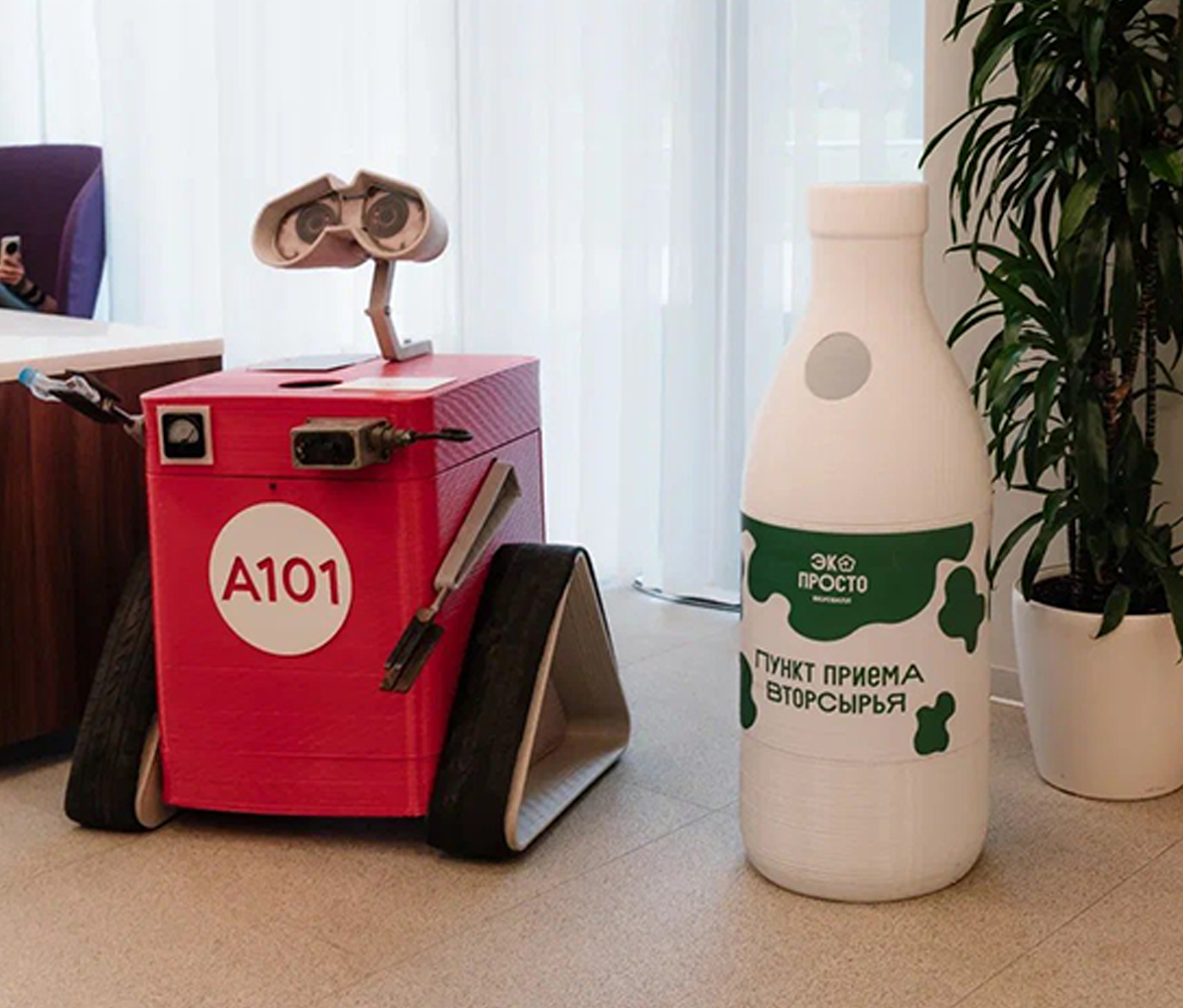
For a shop, office or event, the container can become a visible standalone object. TrashBack can large-format print an enclosure from recycled plastic — for example in the shape of a brand’s packaging — while the digital collection flow remains in the app.
The point therefore combines collection infrastructure with customer communication. TrashBack estimates that a solution without on-board electronics can cost 6–10 times less than a conventional electronic RVM; the actual project price depends on the enclosure, quantity and use case.
What is changing in the market
RVMs are most effective in deposit-return systems. EU Regulation 2025/40 sets a 90% separate-collection target for single-use plastic bottles and metal beverage containers by 2029 and provides for deposit-return systems unless a member state qualifies for an exemption.
The practical question in Russia is different: how to lower the cost per point, retain auditable accounting and give a brand a clear incentive mechanism. TrashBack’s evolution is a shift from an expensive machine to a digital layer that can connect to different infrastructure formats.
The takeaway
A reverse vending point no longer has to be a large electronic cabinet. If identification, anti-fraud, rewards and analytics run in an app, the physical point can be a branded enclosure or an existing container. The choice starts with the task: what to collect, where to place the point, how to motivate users and what data the partner needs.
Sources and data boundaries
International dates and regulation were checked against primary sources. TrashBack development stages follow the internal product timeline; the cost comparison is identified as a company estimate, not a universal market price.